


Sustainability has a language problem. Walk down any grocery aisle and you’ll encounter a growing vocabulary of environmental virtue.
Organic.
Natural.
Clean.
Regenerative.
Climate-smart.
Responsibly sourced.
Planet-friendly.
Some of these terms are tightly defined. Others are guided by policy. Others are governed by third-party certifications. And some are little more than marketing language wrapped in earth tones and good intentions. And much of that language shows up first through packaging design, where materials, colors, and claims work together to shape buyer perception.
To consumers, however, many of these words feel interchangeable. That confusion may be one of the biggest sustainability challenges facing brands today. As sustainability has moved from niche concern to mainstream expectation, language has become one of the industry’s most powerful—and most vulnerable—tools. The result is a marketplace where consumers often struggle to distinguish between what is proven, what is certified, and what is merely implied.
The question is no longer whether brands are talking about sustainability. It’s whether consumers can tell the difference between sustainability claims that are substantiated and those that simply sound sustainable. That distinction matters because consumers are becoming increasingly critical evaluators of sustainability messaging. Recent research found that 70% of consumers actively verify sustainability claims for themselves, while more than half suspect some brands may be overstating their environmental impact (The Reynolds Center, 2025).
Not All Green Claims Are Created Equal
As sustainability moves from niche concern to mainstream expectation, brands are racing to communicate environmental benefits in ways consumers can easily understand. The challenge is that not all sustainability claims carry the same weight. Some are backed by formal standards and verification systems. Others rely primarily on consumer perception and cultural meaning. Many sit somewhere in between.
Understanding these differences matters because the next wave of consumer trust—and skepticism—will be shaped by how these claims evolve. The same ambiguity that once surrounded terms like “natural,” “eco-friendly,” and “clean” is beginning to emerge around newer language such as “regenerative.” Without a clear understanding of what different claims actually require, brands risk overpromising, consumers risk misunderstanding, and regulators increasingly step in to scrutinize the gap.
Most sustainability language falls into four broad categories, each carrying a different level of definition, accountability, and proof. Understanding where a claim sits on this spectrum can help reveal both its credibility and its potential vulnerability to greenwashing.
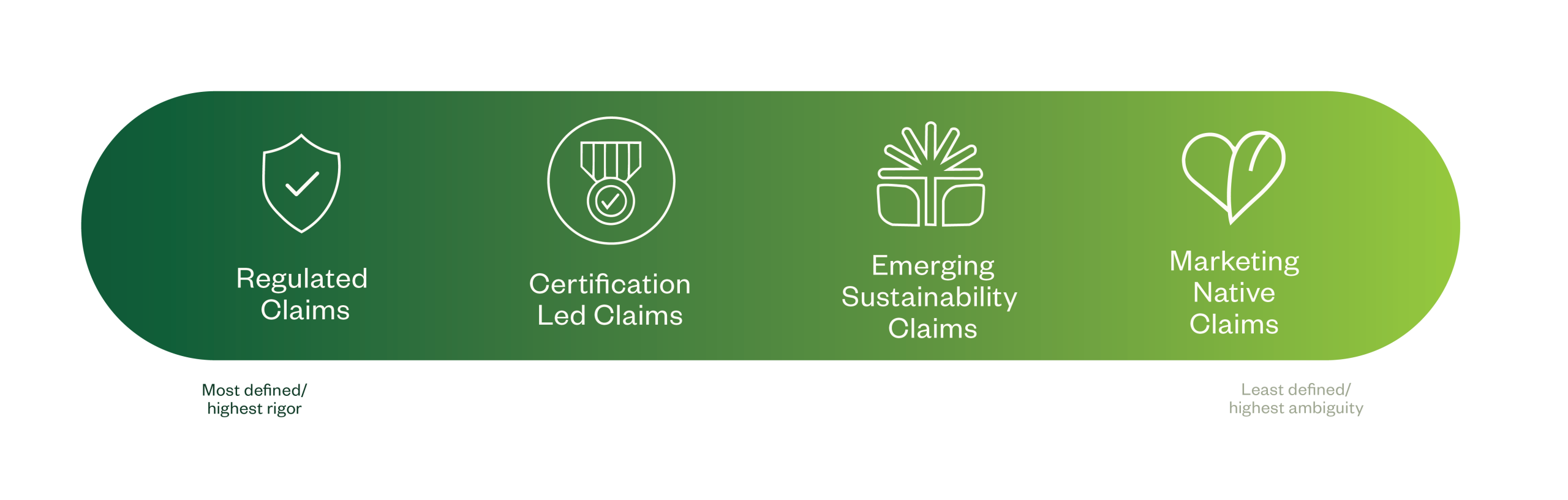
At one end of the spectrum are regulated claims. Organic is one of the strongest examples. Think of brands like Dirtbag Bar, Folkland Foods, or LesserEvil. In the United States, products labeled organic must comply with USDA National Organic Program requirements, including certification standards and labeling thresholds. A product cannot simply decide to call itself organic because it uses a few organic ingredients. The claim is governed by a defined system.
At the other end are marketing-native claims. Words like “clean,” “green,” “planet-friendly,” and “conscious” have enormous cultural appeal but no universally accepted definition. Some brands you might think of in this category are Clean Dough Co., Youth to the People, or Llama Mama. Their meaning is largely determined by the brand using them. Broad environmental claims can become problematic because consumers often interpret them as representing benefits across an entire product lifecycle which is something that is difficult to substantiate.
Between those extremes lives the most interesting territory: certification-led and emerging sustainability claims. This is where today’s sustainability language battle is being fought.
The Rise of Regenerative
Few words have gained momentum faster than regenerative. In just a few years, regenerative agriculture has moved from academic and agricultural circles into mainstream food and beverage marketing. The term evokes healthier soil, biodiversity, carbon sequestration, ecosystem restoration, and long-term stewardship.
It’s a powerful idea. But it’s also a revealing case study in how sustainability language evolves. The commercial momentum behind regenerative agriculture reflects that appeal. The global regenerative agriculture market was valued at approximately $12.7 billion in 2024 and is projected to grow significantly over the next decade. Yet despite growing adoption, regenerative still lacks a single legal definition, creating a gap between marketplace enthusiasm and standardized meaning (Grand View Research, 2025).
Today, regenerative exists in two different forms. The first is certification-backed. Organizations such as Regenerative Organic Certified® and Regenified have established frameworks, measurement systems, and standards for brands seeking verification. Some Brands you can expect to see here are Mariannes Harvest, Patagonia Provisions, or Alec’s Ice Cream. The second is cultural. Brands increasingly reference regenerative ingredients, regenerative farming, or regenerative practices without necessarily participating in a certification system. This can look like brands such as Force of Nature, Blue Bottle Coffee, or Vital Farms.
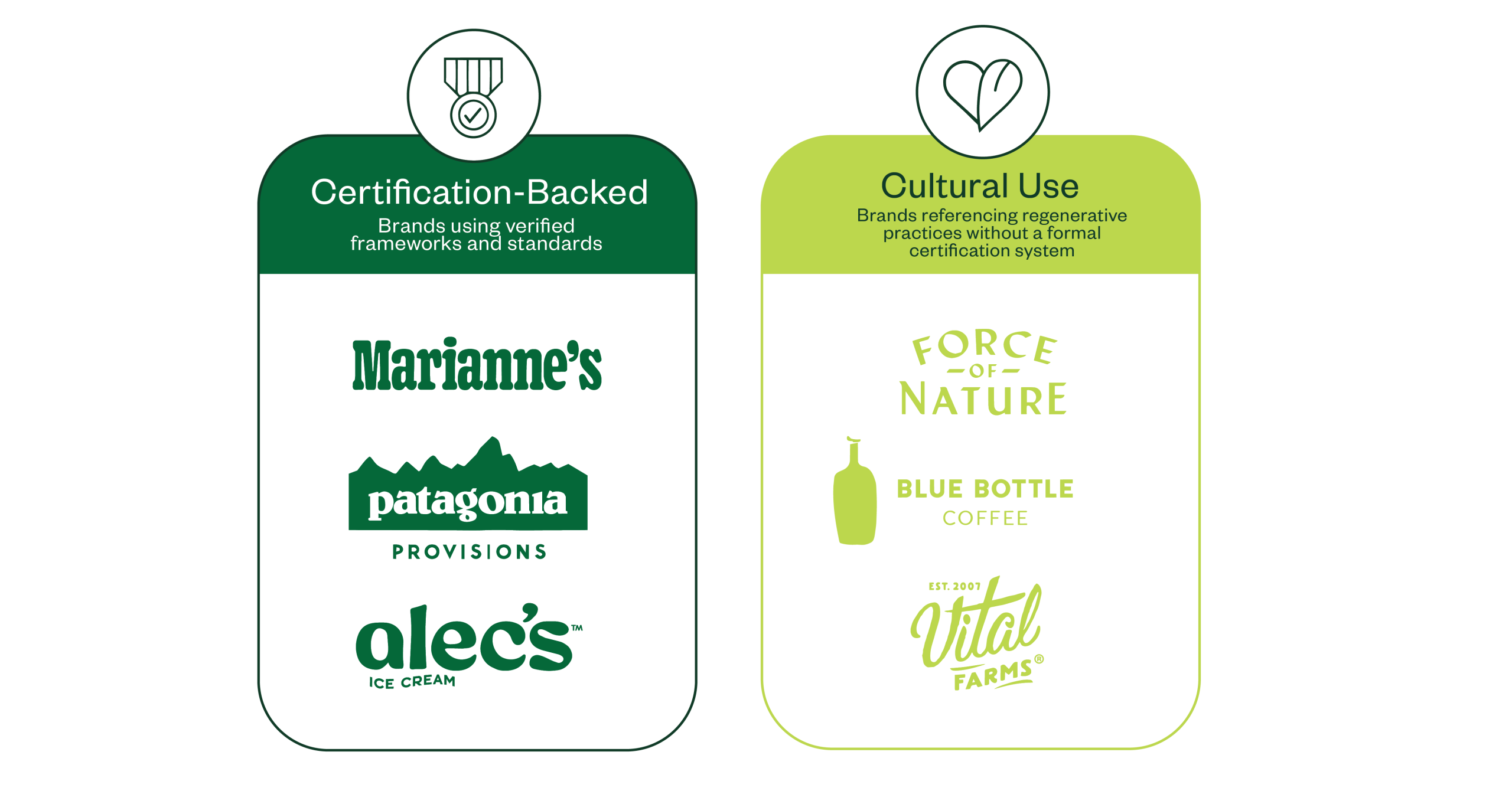
The same word can therefore represent dramatically different levels of rigor. For consumers, those distinctions are often invisible. And that’s where the challenge begins.
What Happens When Language Gets Popular
Historically, sustainability terms tend to move through three phases. First, a term emerges with a relatively specific meaning. Then it gains cultural momentum. Finally, it becomes broad enough that multiple stakeholders begin using it differently. The trajectory of “natural” illustrates this pattern.
Consumers often associate natural with healthier products, fewer chemicals, simpler ingredients, and better environmental outcomes. Yet the term itself has historically lacked the kind of formal regulatory definition consumers often assume exists. FDA has maintained a longstanding policy regarding use of the term but has not established a comprehensive rulemaking definition.
As a result, consumer expectations frequently exceed what the claim guarantees. The risk is that regenerative may be approaching a similar crossroads. Not because the concept lacks value. But because popularity tends to outpace standardization.
The Semiotics of Sustainability
The challenge becomes even more complex when language is combined with packaging design and visual identity. Consumers rarely evaluate sustainability claims in isolation. They evaluate systems of signals:
A leaf icon.
A hand-drawn farm illustration.
Kraft paper textures.
Muted greens.
Sketches of roots.
A founder story.
A certification badge.
Together, these elements create a perception of credibility that can extend beyond the actual claim being made. In many cases, greenwashing doesn’t occur because a single statement is false. It occurs because the overall system implies more than any individual statement says.
A package may never explicitly claim environmental superiority. Yet consumers may still walk away believing it is more sustainable than competing products because every visual and verbal cue points in that direction. This is where sustainability communication becomes less about compliance and more about interpretation.
The New Challenge for Brands
Historically, sustainability communication was often focused on proving effort. Today, consumers increasingly expect proof of impact. They are constantly check apps like Yuka, GreenChoice, and Boycat. That expectation is creating a growing trust gap. While many business leaders believe consumers trust their sustainability communications, consumer research consistently shows skepticism remains widespread. Brands are no longer being evaluated simply on whether they participate in sustainability efforts, but on whether they can clearly explain and substantiate them (Deloitte, 2025).
That shift raises a new question related to the overall brand strategy: How much of a sustainability story should be told through language, and how much should be demonstrated through evidence?
Brands that rely on broad environmental language may find themselves increasingly vulnerable as consumer literacy rises and regulatory scrutiny grows. Brands like Tony’s Chocolate and Dr. Bronner’s, who provide clear evidence, transparent sourcing information, measurable outcomes, and understandable explanations may ultimately earn more trust by saying less. In a crowded marketplace, specificity is becoming a competitive advantage.
A Better Future for Sustainability Language
The next generation of sustainability communication will likely be defined not by bigger claims, but by clearer ones and the brands that win won’t necessarily be the ones using the most ambitious vocabulary. They’ll be the ones with strong brand positioning that helps consumers understand exactly what their claims mean AND what they do not mean.
Sustainability’s biggest challenge may no longer be innovation. It may be translation. And in a marketplace full of environmental promises, clarity is becoming one of the most sustainable assets a brand can own.
ABOUT LPK
LPK is a trusted branding agency specializing in food, beverage, beauty, and wellness. We’ve partnered with brands in and around the regenerative space—including Horizon Organic, Country Natural Beef, Golden Peanut, and Vertical Harvest—to define positioning, build distinctive identities, and design packaging and brand experiences that drive relevance, differentiation, and growth.